
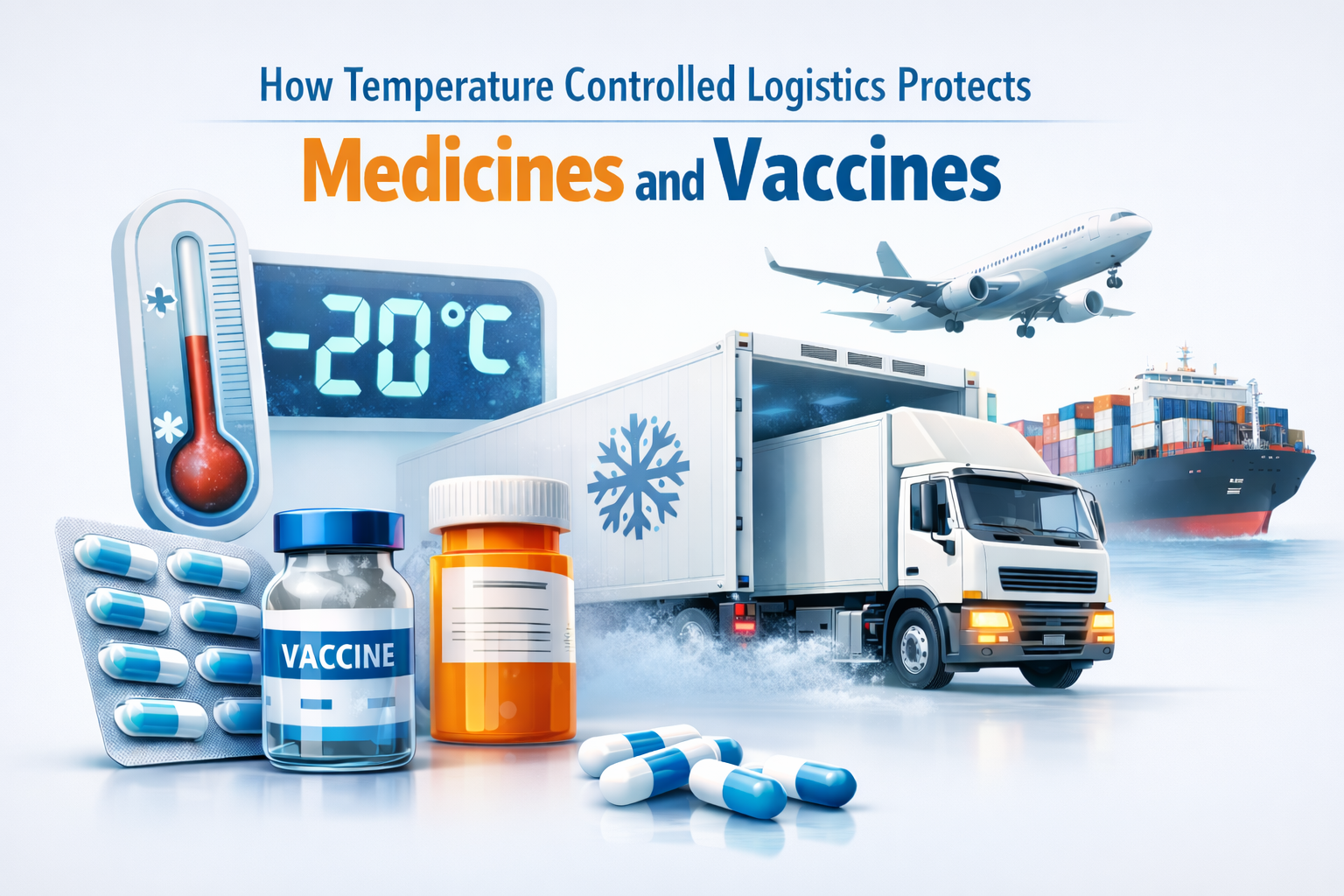
Every Degree Matters: How Temperature Controlled Logistics Protects Medicines and Vaccines
New Delhi, India:
Everfast Freight Forwarders Pvt Ltd, a 30-year-experienced company in freight forwarding and supply chain solutions, supports the safe and compliant movement of medicines, vaccines, and pharmaceutical products across domestic and international markets.
In the realm of healthcare logistics, the margin for error effectively disappears. A mere hours-long delay or a subtle temperature deviation of a few degrees, just outside the allowed range can render life-saving medicines useless. This is precisely why temperature-controlled logistics or the cold chain is far more than a specialized service; it is a profound commitment to public health and human life.
The Non-Negotiable Nature of Temperature Control
The majority of modern medicines, vaccines, and advanced biological products are extremely temperature-sensitive. Their chemical and molecular structures are delicate, making them highly susceptible to degradation from thermal fluctuations. They must be protected equally from excessive heat, which accelerates decomposition, and destructive freezing, which can damage product integrity. If these precise conditions are not maintained consistently from the manufacturing floor to the final point of care, the product’s vital potency will be compromised—and critically, this loss of efficacy is often undetectable by sight, meaning a clinician could unknowingly administer an inactive drug.
A key misunderstanding I’ve encountered over the years is the public’s belief that logistics is merely about physically moving goods. In reality, temperature-controlled logistics is an exceptionally precise and complex procedure, encompassing specialized storage, careful handling, non-stop monitoring, stringent regulatory compliance, and proactive contingency planning at every phase of transit. It requires a mentality that views the supply chain as a protective shield.
Safeguarding the Shipment: A Complete Cold Journey
To appreciate how this system safeguards medical supplies, we must view the entire journey as an interconnected process where integrity is maintained at every handoff.
- Preparation and Packing: The journey starts at the manufacturing facility, where products are packed using validated insulated systems and packaging solutions that have been proven to maintain the required temperature for a specific duration under anticipated external conditions. This may involve advanced phase-change materials, complex gel packs, or specialized active temperature-controlled containers equipped with internal refrigeration units.
- Initial Storage: The shipment then enters certified cold storage warehouses. These facilities, often called distribution centers (DCs), operate protocols for temperature, humidity, and handling, which are constantly monitored, alarmed, and logged. Staff undergo specialized training to ensure the products are handled rapidly and correctly to minimize 'door-open time' and thermal exposure.
- The Critical Transit Phase: Transportation is arguably the most vulnerable stage, particularly during international shipping. Whether traveling by air, sea, or land, the medicine must remain within its specified temperature range and be monitored continuously with advanced systems that transmit real-time data and trigger alerts upon any deviation.
- Risk Management in Transit: During this phase, risk management is paramount. A logistics professional’s job is to anticipate failure points: customs delays, unexpected flight cancellations, or infrastructure failures. We must have pre-approved, documented Standard Operating Procedures (SOPs) for these eventualities.
- Last-Mile Integrity: Finally, proper last-mile delivery ensures the medicines reach hospitals, pharmacies, or distribution centers without exposure to damaging conditions. Every transfer point is formally documented, audited, and verified to maintain a complete chain of custody and a perfect temperature history.
Technology and Expertise: The Cold Chain's Backbone
Today, technology has fundamentally revolutionized how we protect sensitive cargo. We now rely on sophisticated sensors, GPS tracking, and automated, border-crossing alert systems that transmit continuous data to cloud platforms. This allows logistics teams to monitor the shipment 24 hours a day, 7 days a week,
However, a core principle we champion at Everfast Freight is that technology is only as effective as the personal expertise in it. The raw data is invaluable, but the capacity to interpret that data and act immediately is what ultimately protects the cargo. An unexpected customs hold, a sudden airport delay, or an unpredicted extreme weather event all pose serious risks but with experienced, seasoned professionals and proactive contingency planning, these risks are effectively neutralized.
Discipline, Precision, and Sustainability
Healthcare logistics is governed by incredibly strict regulatory frameworks, notably those related to patient safety and drug efficacy. Good Distribution Practices (GDP), national customs laws, airline handling standards, and country-specific compliance are all crucial for guaranteeing product integrity. Ignoring them is not an option; it is a clinical and legal liability.
What I've learned over the decades is that it is about applying a strong culture of discipline. Every individual in the logistics, from the documentation team and the drivers to the warehouse must fully grasp the immense responsibility they bear. A single overlooked procedure, like failing to sign a temperature log or briefly leaving a pallet on an uncontrolled tarmac, can unfortunately compromise an entire, vital shipment.
For the Best Results
As medical innovation accelerates, logistics will confront even sharper challenges. The future will bring personalized medicines, advanced cell therapies, and sophisticated biologics demanding unprecedented precision in temperature management and near-instant delivery times.
Precision and Sustainability will become a primary focus, pushing the industry to significantly reduce its environmental footprint. We are seeing a move toward reusable packaging, lighter insulation materials, and the use of sustainable coolants, all while upholding the strictest temperature standards. The future of healthcare logistics belongs to organizations that can seamlessly integrate deep experience, powerful technology, and an unwavering sense of environmental and social responsibility.
Closing Remarks
After three decades in this challenging field, I can confidently state that Everfast Freight Forwarders Pvt Ltd temperature-controlled logistics is the most deeply meaningful area of our work.
At Everfast Freight Forwarders Pvt Ltd single shipment of medicine or vaccine we handle represents a tangible piece of hope for recovery, for disease prevention, and for a better quality of life. Protecting that hope is the ultimate responsibility we uphold every day.