
Buffer Stock vs Bottom Line: How Much Inventory is Safe in a Volatile Global Market?
Buffer Stock vs. Bottom Line:
How Much Inventory is "Safe" in a Volatile Global Market?
Today, businesses are shifting toward "Just-in-Case" strategies. But how much buffer stock is too much? At Everfast Freight, we see firsthand how over-stocking can trap capital, while under-stocking can lead to lost contracts.
Here is how to find your "Safe Zone" in 2026.
The Cost of "Too Lean": The Hidden Drain on Your Bottom Line
When you carry zero buffer stock, you aren’t just saving on warehousing; you are gambling on perfection. In a volatile market, being "too lean" often results in:
- Expedited Shipping Fees: When stock runs low, you’re forced to pay premium air freight rates instead of economical sea freight.
- Production Stoppages: For manufacturers, a $5 delayed component can halt a million-dollar production line.
- Lost Customer Trust: In the era of instant gratification, "Out of Stock" is an invitation for your customer to visit a competitor.
The Danger of Over-Stocking: When Buffer Becomes Burden
On the flip side, "Just-in-Case" can quickly erode your profit margins. Excessive inventory leads to:
- Capital Tie-up: Money sitting on a shelf is money that isn’t being invested in marketing or R&D.
- Obsolescence Risk: In fast-moving industries like tech or fashion, stock loses value every day it sits in a warehouse.
- Increased Storage Overheads: Higher insurance, utility costs, and labor for inventory management.
Calculating the "Safe" Zone: 3 Key Metrics
To find the equilibrium between your buffer stock and your bottom line, monitor these three variables:
1. The Lead Time Variance
Total lead time isn't just the time a ship spends on the water. It is a chain of events, each with its own variance:
- Production Lead Time: How long the factory takes to manufacture the goods.
- Transit Lead Time: The actual journey (Sea, Air, or Road).
- Administrative Lead Time: Customs clearance, port handling, and last-mile delivery.
The Reality: If your supplier says "30 days," they are usually quoting the Transit time. They aren't accounting for a 5-day port strike or a 3-day customs backlog.
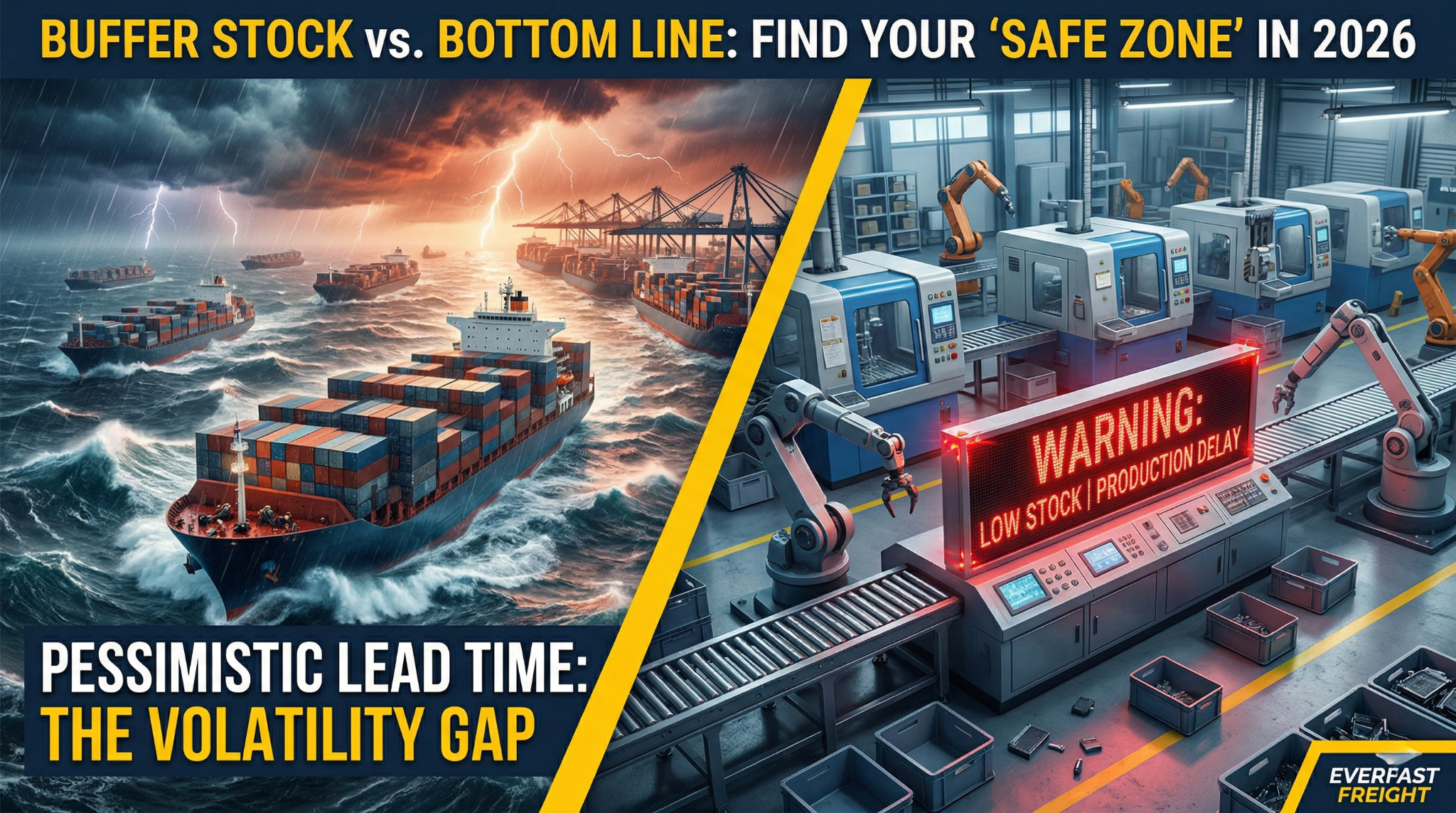
The Volatility Gap is the difference between your Average Lead Time and your Pessimistic Lead Time.
Example:
- Ideal Lead Time: 30 Days (The "Standard")
- Actual Recent Performance: 45 Days (Due to Red Sea diversions or Port congestion)
- Your Volatility Gap: 15 Days.
If you only hold 30 days of stock, you are effectively "dark" for two weeks.
2. The Service Level Agreement (SLA)
To determine your safe inventory level, you must ask: “What happens if the shelf is empty?” The answer varies wildly across industries, and this determines your Safety Stock requirements.
High Criticality (The "Must-Have" SLA)
- Industries: Healthcare, Automotive (Original Equipment Manufacturers), and Food & Beverage.
- The Scenario: If a hospital needs a specific stent or a factory needs a specific bolt, they cannot wait.
- The Cost of Stockout: Massive fines, loss of life-long contracts, or complete production shutdowns.
- Logistics Strategy: You need a High Buffer. You should maintain enough stock to cover the 99th percentile of demand spikes.
Low Criticality (The "Expectation-Managed" SLA)
- Industries: Custom Furniture, High-end Fashion, and Specialized Machinery.
- The Scenario: A customer ordering a bespoke sofa already expects a 4-to-8 week lead time.
- The Cost of Stockout: Minor frustration or a slightly delayed delivery date, but rarely a lost customer.
- Logistics Strategy: You can afford a Lean Buffer. Since the customer is "paying in time," you can keep your capital fluid and rely on slower, more cost-effective shipping lanes like sea freight.
3. Inventory Turnover Ratio
- A High Ratio indicates you are moving goods quickly. This is generally "healthy," though if it's too high, you might be under-stocking and missing sales.
- A Low Ratio suggests that your "buffer stock" has become "stagnant stock." Your money is sitting in a warehouse, collecting dust and incurring storage fees instead of generating profit.
4. The Role of Digital Twins in Inventory Planning
In 2026, "guessing" your buffer stock is no longer necessary. By creating a Digital Twin—a virtual model of your entire supply chain—you can run "What If" simulations.
- Stress Testing: What happens to your bottom line if a major port closes for 10 days?
- Scenario Planning: A Digital Twin allows you to see the financial impact of increasing your buffer by 10% versus the cost of a potential stockout.
5. Shifting to "Multi-Sourcing" to Reduce Buffer Needs
One of the most effective ways to protect your bottom line without over-stocking is supplier diversification.
- The Logic: If you rely on a single factory in one geographic region, your buffer stock must be massive to cover regional disruptions (like weather or policy changes).
- The Strategy: By sourcing from two different regions—for example, Vietnam and India—you can maintain lower individual buffers because the statistical likelihood of both supply lines failing simultaneously is much lower.
6. Strategic Use of Bonded Warehousing
For businesses worried about the "Bottom Line" part of the equation, Bonded Warehousing is a game-changer.
- Duty Deferment: You can keep your buffer stock in a bonded warehouse without paying import duties until the moment the goods are actually cleared for the local market.
- Cash Flow Management: This allows you to have the "safety" of physical stock nearby without the immediate tax hit to your capital.
How Everfast Freight Helps You Balance the Scale
Navigating global volatility requires more than just a warehouse—it requires visibility.
At Everfast Freight, we provide the data-driven insights you need to optimize your stock levels. By leveraging real-time tracking and predictive analytics, we help you anticipate delays before they hit your balance sheet. Whether it’s optimizing your sea-to-air transitions or managing bonded warehousing to defer duties, we ensure your supply chain is resilient without being bloated.