
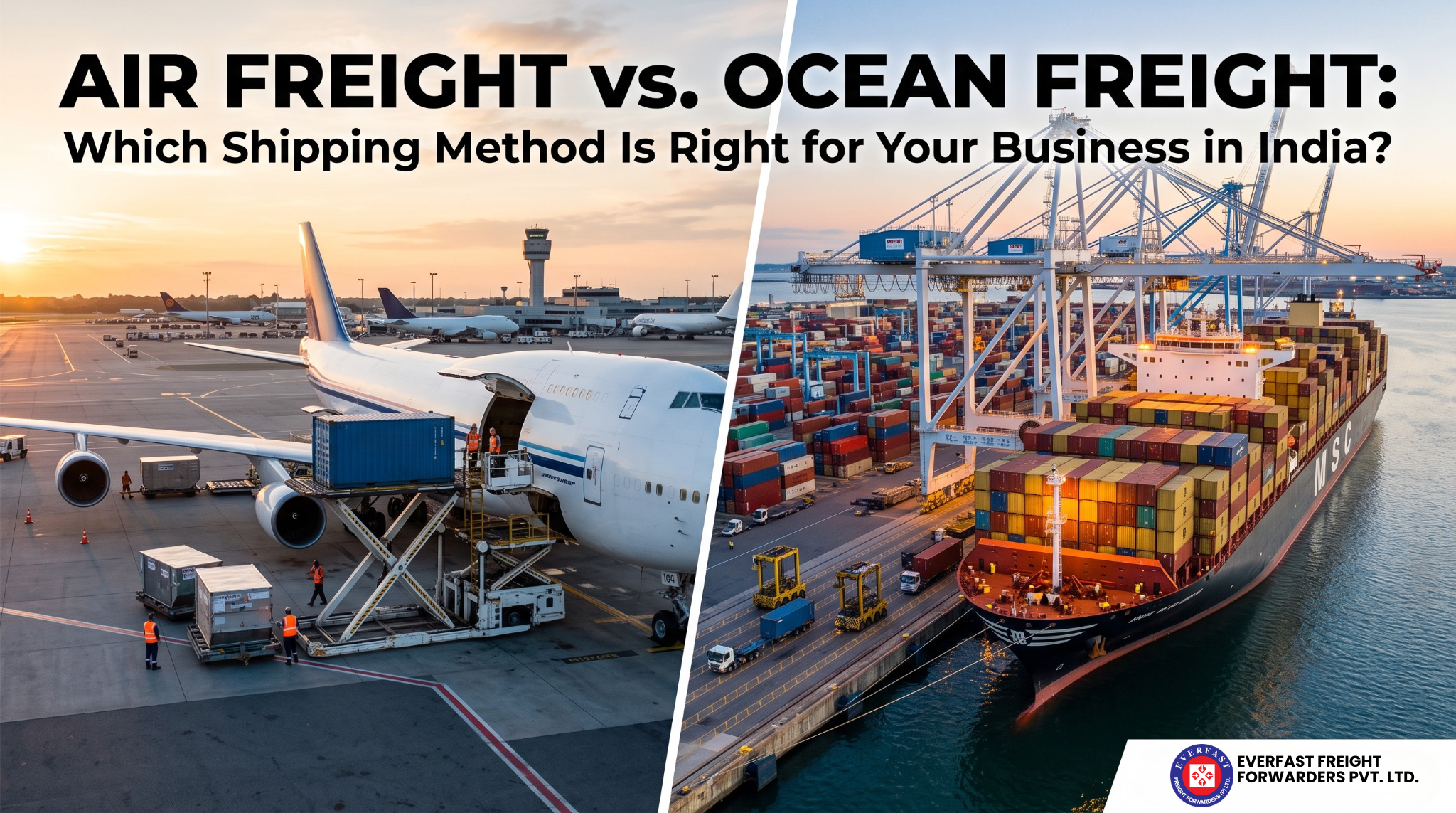
Air Freight vs Ocean Freight: Which Shipping Method Is Right for Your Business in India?
Why This Decision Matters
Every international shipment starts with one question: air or ocean? The answer affects cost, delivery time, packaging, insurance, and how much working capital gets tied up in transit. For businesses moving goods in and out of India whether it's garments to Europe, electronics components from East Asia, or pharmaceuticals to the Middle East getting this choice right can be the difference between a healthy margin and an eroded one.
This isn't a one-time decision either. Trade lanes shift, fuel surcharges rise and fall, buyer expectations change, and a business that ships the same way for every order regardless of circumstances is almost certainly leaving money on the table somewhere in its supply chain. The goal of this guide is to give you a repeatable framework, not just a rule of thumb, so the decision gets made consciously on every shipment rather than defaulted to habit.
How Air Freight Forwarding Actually Works
Air freight moves through a fairly standardized sequence: cargo is booked with an airline or consolidator, delivered to an origin airport's cargo terminal, screened and documented under an airway bill, flown often via a hub to the destination airport, and then cleared through customs before final delivery. From major Indian gateways like Delhi, Mumbai, Bengaluru, and Chennai, most global destinations are reachable within one to five days of flight time, though total door-to-door time also includes trucking, screening, and customs clearance on both ends.
A freight forwarder's role in air cargo is to consolidate smaller shipments into larger bookings to secure better rates, choose the right routing (direct vs. transshipment), manage the airway bill and export documentation, and coordinate with a destination agent or its own branch office for customs clearance and final delivery.
How Ocean Freight Actually Works
Ocean freight in India moves through major gateway ports Jawaharlal Nehru Port (Nhava Sheva) near Mumbai, Mundra, Chennai, Kolkata, and Kandla among others via container vessels operating on fixed weekly or bi-weekly sailing schedules. A shipment is booked as either Full Container Load (FCL), where the shipper takes an entire container, or Less than Container Load (LCL), where cargo is consolidated with other shippers' goods heading to the same destination.
Transit time depends heavily on the trade lane: roughly 18-24 days to Northern Europe, 25-35 days to the US East Coast, 12-18 days to the Middle East, and as little as 5-10 days to Southeast Asia. Each port also carries a 'free time' window typically 3-7 days before demurrage and detention charges begin accruing on the container, which is an important cost variable many first-time shippers overlook.
Breaking Down the Real Cost Difference
Air freight is typically four to six times more expensive per kilogram than ocean freight, but the comparison isn't quite that simple. Air freight pricing uses chargeable weight the greater of actual weight or volumetric weight (calculated as length × width × height in centimeters, divided by 6000) so bulky-but-light cargo like garments or electronics packaging can cost far more than its actual weight suggests.
Ocean freight costs are driven by container type and size, origin and destination terminal handling charges (THC), documentation fees, and critically free time management, since demurrage and detention charges at destination can silently add hundreds of dollars per container if cargo isn't cleared and collected promptly. Fuel surcharges (BAF for ocean, fuel surcharge for air) fluctuate with global oil prices and should always be confirmed at time of booking rather than assumed from a previous quote.
Speed, Reliability, and Schedule Frequency
Air cargo capacity is generally more predictable in terms of transit time once booked, but availability itself can tighten sharply during global events, e-commerce peak seasons, or when passenger flight capacity (which carries significant belly cargo) is reduced. Ocean freight offers fixed sailing schedules that are easy to plan around, but is more exposed to port congestion, equipment shortages (container availability), and seasonal capacity crunches notably around Chinese New Year and the pre-Christmas retail peak, when rates can spike and space can be hard to secure without booking weeks in advance.
Matching Cargo Type to the Right Mode
Some cargo categories have a clear default. Perishables fresh produce, cut flowers, and certain food products almost always move by air because of shelf-life constraints. Pharmaceuticals and biologics with strict shelf-life or temperature-sensitivity windows typically move by air for the same reason, unless volumes are large enough to justify temperature-controlled ocean containers on a longer-life product. Heavy machinery, industrial raw materials, furniture, and bulk consumer goods almost always move by ocean, since air freight costs would erase any margin on low-value-per-kilo goods.
High-value electronics sit in a gray zone: air freight reduces theft, damage, and obsolescence risk for fast-moving consumer electronics, while ocean freight is often used for components with longer product life cycles. Fashion and garments frequently split by season regular seasonal stock moves by ocean, while urgent replenishment or trend-sensitive drops move by air to hit retail windows.
Sustainability and ESG Considerations
Carbon intensity per ton-kilometer is dramatically lower for ocean freight than for air freight, and this is no longer just a marketing talking point. Buyers in the EU and other markets are increasingly asking suppliers to report shipment-level emissions as part of Scope 3 reporting obligations and carbon border adjustment mechanisms. Exporters who can show a deliberate strategy using ocean freight wherever transit time allows, and reserving air freight for genuinely time-critical shipments are better positioned to meet these buyer requirements without a costly last-minute scramble.
A Practical Decision Framework
Four questions should be asked before booking any shipment. First, how time-sensitive is the order does a delay trigger contractual penalties, lost retail windows, or reputational damage with the buyer? Second, what is the value-to-weight ratio of the cargo high-value, low-weight goods absorb air freight costs far better than low-value, heavy goods. Third, is the cargo perishable, fragile, or regulated in a way that shortens its usable transit window? Fourth, and most overlooked, what is the actual landed cost once packaging, insurance, demurrage risk, and inventory carrying cost are added to the base freight quote not just the headline rate a forwarder first quotes.
Many mature exporters run a deliberately hybrid model: ocean freight covers base inventory and steady replenishment cycles, while air freight is reserved for urgent top-ups, new product launches, or recovery from an unexpected ocean delay. This isn't indecision it's a considered cost-optimization strategy that a good freight partner should actively help you model rather than simply execute whichever mode you request by default.
Common Mistakes Businesses Make
The most frequent error is defaulting to whichever mode was used last time without re-evaluating the shipment's specific circumstances. A close second is ignoring volumetric weight rules until an unexpectedly high air freight invoice arrives. Many businesses also fail to book ocean freight far enough ahead of peak season, only to find space unavailable or rates significantly elevated. Finally, a surprising number of shippers calculate 'cost' using only the freight quote, missing demurrage, detention, and inventory carrying costs that can flip the true economics of a decision.
Shipping from India's Key Gateways: Regional Considerations
The right mode can also depend on where in India your goods originate. Exporters based near Delhi and the National Capital Region typically route air cargo through Delhi's Indira Gandhi International Airport and ocean cargo overland to Mundra or Nhava Sheva, adding a few days of inland transport before the main international leg even begins. Businesses in Mumbai, Chennai, or Kolkata benefit from more direct port access, which can shrink total transit time and reduce the inland trucking cost that's easy to overlook when comparing headline freight rates between cities.
This is one more reason a freight forwarder's actual branch network matters: a provider with strong local presence at your specific origin city can consolidate cargo faster, secure better rates through volume aggregation at that location, and reduce the inland transport leg that both air and ocean shipments share regardless of which international mode is ultimately chosen.
Insurance Considerations for Air vs Ocean Cargo
Cargo insurance terms and premiums also differ meaningfully between the two modes. Air freight's shorter transit time and lower handling frequency generally translate into lower insurance premiums relative to cargo value, while ocean freight's longer transit and additional handling steps loading, discharge, potential transshipment carry a somewhat higher risk profile that insurers price accordingly. For high-value cargo, this differential is worth factoring into the total cost comparison between modes, not just the freight rate itself.
It's also worth checking whether your cargo insurance policy has any exclusions specific to mode some policies, for instance, apply different deductibles or require additional declarations for break-bulk or transshipment movements, which is another detail a broker familiar with both modes should flag proactively rather than leaving you to discover after a claim.
Peak Season Planning for Both Modes
Air freight capacity tightens sharply around global e-commerce peaks and major shopping seasons, since a meaningful share of air cargo capacity rides on passenger aircraft whose schedules don't flex to match cargo demand. Ocean freight faces its own seasonal pressure points, particularly the weeks before and after Chinese New Year when Asian manufacturing and shipping activity compresses into a shorter window, and the pre-holiday retail season when Western import demand peaks. Businesses that build peak-season booking lead times into their planning rather than booking at the last minute and accepting whatever rate and capacity is available consistently fare better on both cost and reliability.
Building a Hybrid Freight Strategy
Many businesses run a hybrid model: ocean freight for base inventory and steady replenishment, air freight for urgent top-ups or new product launches. A freight forwarder with both air and ocean capabilities plus warehousing and customs clearance under one roof can model both scenarios and recommend the lower total-cost option per shipment rather than a one-size-fits-all policy.
How Everfast Freight Helps
Everfast Freight has managed both air and ocean freight forwarding for Indian businesses since 1997, with our own offices at major airports and seaports across the country rather than relying solely on third-party agents. Our teams calculate landed-cost scenarios for both modes before a shipment is booked, factoring in surcharges, demurrage risk, and inventory carrying cost, so the mode decision is based on data specific to your shipment rather than habit or a single-line freight quote.
Frequently Asked Questions
Is air freight always faster than ocean freight?
Almost always for the transit leg itself, but total door-to-door time also depends on customs clearance, inland transport, and consolidation schedules on both ends factors a good freight forwarder manages regardless of mode.
Can I mix air and ocean freight for one order?
Yes. Many exporters split urgent quantities by air and the bulk of an order by sea, especially around new product launches, peak retail seasons, or when recovering from an unexpected delay in the primary shipment.
Which is better for perishable or pharma goods?
Air freight is generally preferred for perishables and time-sensitive pharma products, though temperature-controlled ocean freight is used for larger, less time-critical pharma and food shipments where the product's shelf life allows for a longer transit.
What is volumetric weight and why does it matter?
Volumetric weight estimates the space a shipment occupies rather than its actual mass, calculated as length × width × height in centimeters divided by 6000 for air freight. Airlines charge based on whichever is greater actual or volumetric weight so bulky, lightweight cargo can cost significantly more than its physical weight would suggest.
How far in advance should I book ocean freight during peak season?
During peak periods like the pre-Chinese New Year rush or the pre-holiday retail season, booking two to four weeks ahead is advisable to secure both container availability and stable rates.
Does the choice of mode affect my sustainability reporting?
Yes ocean freight has a significantly lower carbon footprint per ton-kilometer than air freight, and an increasing number of international buyers request shipment-level emissions data as part of their own ESG and supply chain reporting.
Does my origin city in India affect which mode makes more sense?
Yes inland trucking distance to the nearest suitable airport or port adds cost and time regardless of the international mode chosen, so a forwarder with strong local presence at your specific origin city can meaningfully improve overall transit time and cost.
Is cargo insurance more expensive for one mode than the other?
Ocean freight's longer transit time and additional handling steps generally carry a somewhat higher risk profile than air freight, which insurers typically reflect in the premium relative to cargo value.